
This article was written by Mike Flache and originally published on BBN Times.
Key takeaways
- AI must be treated as a strategic growth asset, not just an efficiency tool. Its value lies in transforming business models, unlocking new revenue streams, and strengthening competitive positioning, not merely optimizing existing processes.
- Sustainable value creation with AI depends on data quality, adoption, and responsible use. High-quality data, strong internal buy-in, and ethical frameworks are critical to fully realizing AI’s potential and to avoid operational and reputational risks.
- C-level leadership determines whether AI drives business impact. Executives must link AI investments directly to value creation, align them with long-term strategy, and actively shape how AI is embedded across the organization to enable sustainable growth.
Artificial intelligence is more than just increasing efficiency; it transforms business models and opens up new growth opportunities.
For C-level executives, data quality, acceptance within the company, and responsible use of AI are key challenges to exploiting the full potential of this technology.
Digital transformation is no longer a future trend but an immediate reality that presents companies worldwide with new challenges and opportunities.
Artificial intelligence (AI) plays a central role in this development. When I look at companies, I see that many have already taken the first steps towards implementing AI technologies. Nevertheless, decision-makers often ask me the same question: How can AI be used strategically to not only optimize processes but also achieve sustainable business growth?
For the board and management, the focus is not on the technical implementation but on how AI can function as a value-creation machine.
The strategic importance of Artificial Intelligence
AI offers much more than just operational efficiency improvements. Its true strategic power lies in its ability to open up new business areas and revolutionize existing models.
Companies like Amazon and Alphabet have shown it – they use AI to continuously expand their business models and consolidate their market position. One advice I give C-level decision-makers in this context is to view AI not just as a technical tool but, above all, as a strategic asset.
The decision to invest in AI should always be linked to the question: “How can this technology sustainably transform our business model?”
Value creation potential through AI
The value-creation potential of AI is enormous, especially in areas such as personalized marketing, predictive analytics, and automated decision-making.
Take the financial industry, for example, where companies use AI to better understand customer preferences and offer customized products. This personalization not only leads to higher customer satisfaction but also to a significant increase in sales.
Another example is the manufacturing industry, where AI can optimize supply chains, minimize downtime, and thus maximize operational efficiency.
The conclusion is clear: When used properly, AI can directly contribute to increasing sales and improving competitiveness.
Challenges and solutions
Despite the immense benefits of AI, companies face significant challenges when integrating this technology.
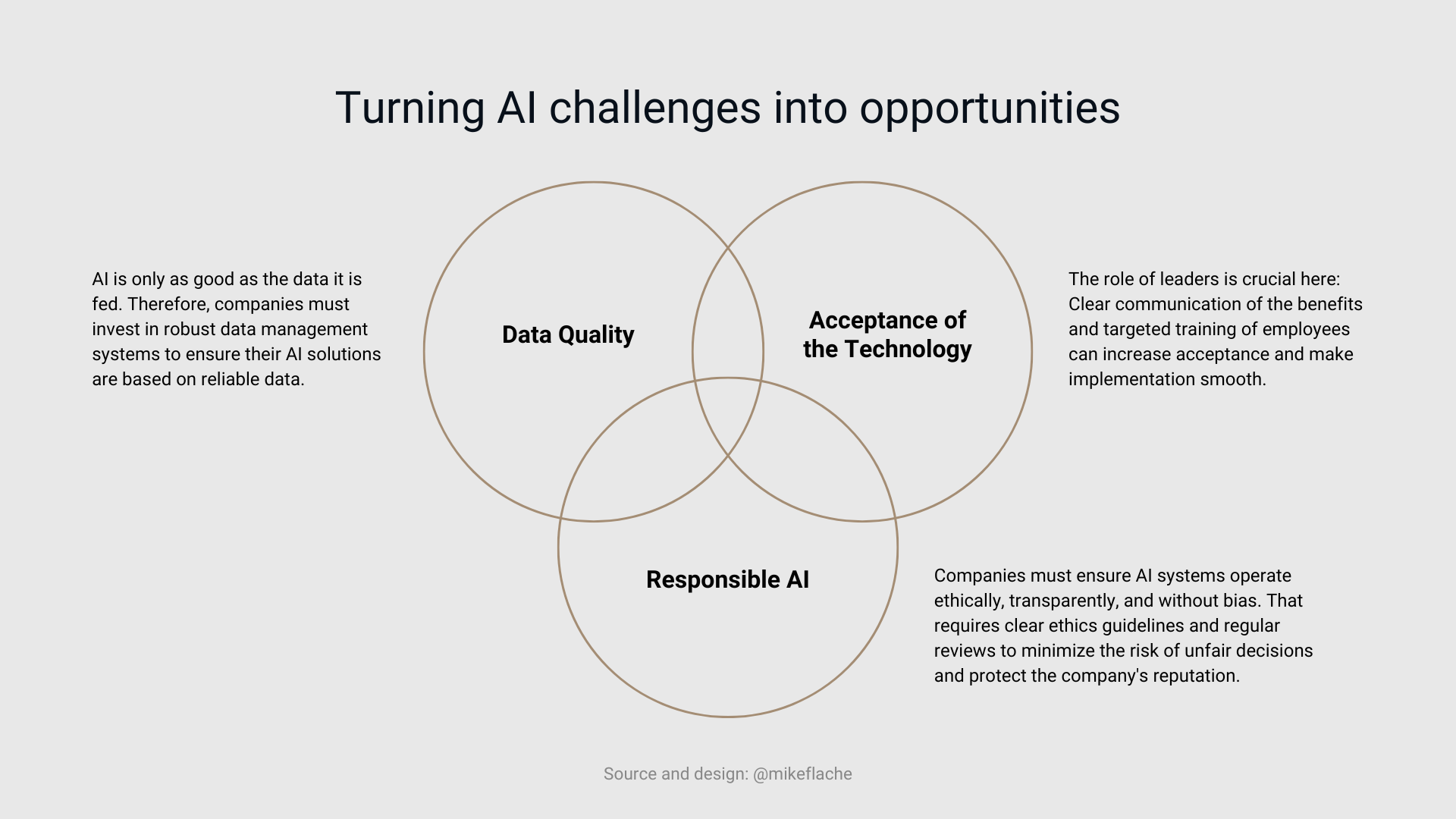
One of the biggest hurdles is data quality: AI is only as good as the data it is fed. Therefore, companies must invest in robust data management systems to ensure their AI solutions are based on reliable data.
Another challenge is the acceptance of AI technology within the company. The role of leaders is crucial here: Clear communication of the benefits and targeted training of employees can increase acceptance and make implementation smooth.
A third challenge is responsible AI. Companies must ensure AI systems operate ethically, transparently, and without bias. That requires clear ethics guidelines and regular reviews to minimize the risk of unfair decisions and protect the company’s reputation.
To sum up
Against this background, I recommend that C-level decision-makers gain clarity about the strategic use of artificial intelligence in their companies. At its core, it is about the opportunity not only to prepare for the digital future but to actively shape it.
The board and management must recognize AI as the key to value creation and align their investment decisions accordingly. Those who manage to integrate AI effectively will not only transform their business model but will also be able to achieve sustainable growth.
Therefore, the question is: How can your company use AI to reach the next level of growth?
Cover image: Douglas Lopez on Unsplash
Disclaimer: The information provided in this article is solely the author’s opinion and not investment advice—it is provided for educational purposes only. By using this, you agree that the information does not constitute any investment or financial instructions. Do conduct your own research and reach out to financial advisors before making any investment decisions.